Giant Lily Revealed!

Caleb Ryan
| 25-11-2026
 · Plant Team
A photograph shared on social media can sometimes lead to a scientific discovery far beyond what the person who posted it expected. That was the starting point for the recognition of Victoria colombiana, a giant waterlily growing in a remote part of eastern Colombia.
Although its enormous floating leaves could be spotted in satellite images, the plant had escaped formal scientific recognition. Identifying it required more than looking at photographs: researchers needed fieldwork, careful comparisons and knowledge from people familiar with the region.
A Remarkable Member of the Waterlily Family
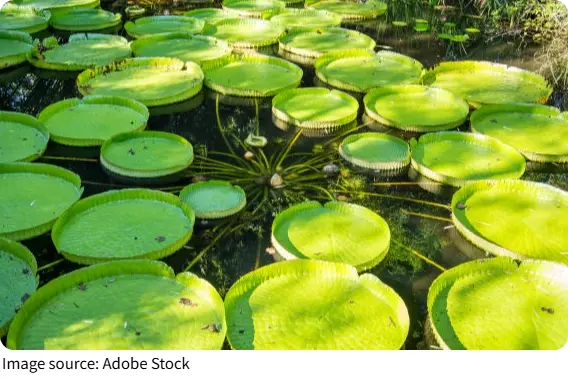
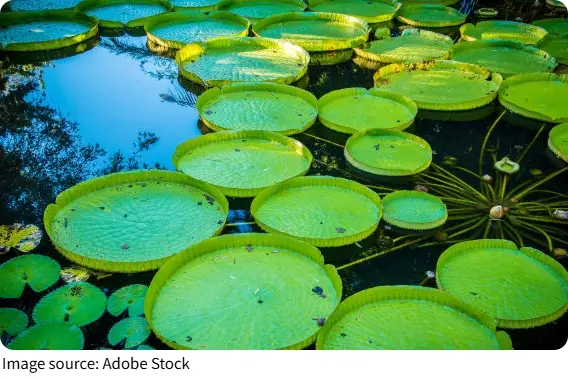
The genus Victoria belongs to the waterlily family, Nymphaeaceae. Its members are particularly well known for their enormous floating leaves, which can sometimes grow beyond three metres in diameter. Strong networks of ribs support the leaves from underneath, where numerous sharp prickles can also be found.
Their flowers have an unusual two-night cycle. They open with white petals on the first night before turning pink on the second. This flowering pattern is part of what makes giant waterlilies so distinctive.
An Unexpected Clue on Instagram
The story of Victoria colombiana began in 2021, when Carlos Magdalena, a waterlily specialist at the Royal Botanic Gardens, Kew, encountered photographs taken by Jeremiah Haris. The images showed a giant waterlily growing near Inírida, in eastern Colombia, close to the borders with Venezuela and Brazil.
The plant had initially been identified as Victoria amazonica. However, Magdalena noticed something unusual about its location. No Victoria species had previously been recorded in that particular area.
This geographical detail encouraged him to investigate further. He examined satellite images of the surrounding landscape and spotted what appeared to be large waterlily leaves floating in several lagoons.
An Expedition With an Unexpected Guide
In July 2024, Magdalena joined researchers from Bogotá's botanical garden and members of local Indigenous communities for an expedition into the flooded forests around Inírida. The first five days proved difficult. The group located only two waterlilies, and neither was flowering. This created a problem because the researchers needed flowering material to describe the plant formally.
Late one evening, Magdalena discussed the situation with Gustavo Melo, their boatman, who belonged to the local Tucano community. Melo knew where additional plants could be found and offered to guide the team. At around 1 a.m., the group entered the flooded forest in darkness. They travelled through the area with Melo's guidance and reached a small lake shortly before sunrise. There, they found five more waterlilies. Most importantly, one of them was flowering.
The team finally had the specimens needed for their research and was still able to catch its scheduled flight back to Bogotá. The experience demonstrated how local knowledge could make a significant contribution to botanical fieldwork.
What Makes the Species Different?
At first glance, Victoria colombiana looks very similar to Victoria amazonica. However, researchers identified several physical features that distinguish the two plants. The flowers of Victoria colombiana have shorter prickles that grow more closely together. Unlike the sharper structures that might be expected, these prickles are surprisingly flexible.
These physical differences, together with the plant's geographical distribution, provided the evidence needed to recognise it as a separate species. The findings were described in a scientific study published shortly before the Botany One article appeared in November 2026.
Why Did It Remain Unnoticed?
One obvious question is how such a large plant could have remained unrecognised for so long. Its leaves can reach approximately two metres across, making them large enough to appear in satellite photographs. The answer may lie in the conditions of its habitat. The plants grow in remote lagoons surrounded by forests that flood seasonally. Accessing these locations is difficult, and researchers cannot easily inspect every possible growing site.
Clues About Plant Evolution and Conservation
The discovery also offers insight into the history of giant waterlilies in South America. Different Victoria species tend to occupy separate river basins. Researchers believe that their seeds cannot survive drying out and are mainly carried through rivers and floodwaters. Over millions of years, changes in river routes and the separation of waterways may have helped populations develop into distinct species.
The story of Victoria colombiana shows that scientific discoveries do not always begin in laboratories or planned research projects. An online photograph drew attention to an unusual plant, satellite images helped narrow down its location, and a carefully organised expedition provided the evidence needed to identify it.