Why Trampoline Is Hard

Santosh Jha
| 01-07-2026
 · Sport Team
Hello, Lykkers! Have you ever watched trampoline gymnastics and thought, “That looks like pure fun, just bouncing around”?
I used to think the same thing until I tried it myself. That seemingly effortless flight is built on a mountain of difficulty that most of us never see. Let me walk you through why this sport is so incredibly demanding.
The Terrifying Height
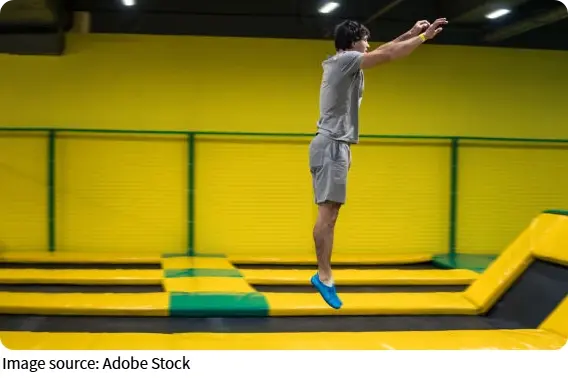
First, the height alone is terrifying. Athletes soar up to 8 meters (about 26 feet) into the air. That is like bouncing off the roof of a two story house. At that height, every tiny mistake in body position multiplies. A slight lean means you won’t land where you planned, and with that much airtime, you have only fractions of a second to adjust. The fear factor is real. Many newcomers freeze mid air because their brain screams “this is wrong.” Learning to override that instinct takes years of practice.
Precision Under Pressure
Then there is the precision of each move. Trampoline gymnasts perform sequences of ten skills in a row, with no pause. Each skill involves flipping and twisting multiple times. For example, a full twisting double backflip means spinning around your own axis while rotating backward twice. Your body must memorize exactly where every limb is at every moment. If your arms drift a few inches, the whole rotation goes off. Judges deduct for the smallest deviation. It is like solving a complex math equation while flying through the air.
Physical Strength and Control
The physical strength required is another layer. Your legs have to absorb the bounce and then push off again with exactly the right force. Too soft and you lose height. Too hard and you lose control. Your core must be rock solid to keep the body tight during rotations. Many athletes train their abs and lower back daily just to stay stable. And the landing? Landing on a trampoline is not soft like a mattress. You need to time the rebound perfectly so your feet hit the bed at the same moment it is coming back up. Mistime it by a tenth of a second and you will crash awkwardly, risking injury.
The Mental Game
But the mental game might be the hardest part. One tiny hesitation can cause a fall. In competition, after a mistake, athletes must immediately adjust their next skill without thinking. That requires a level of mental toughness most of us never develop. They practice the same routine hundreds of times until it becomes automatic, yet still the pressure of performing in front of judges can shake even the best.
Safety and Body Control
Finally, safety is a constant concern. Unlike many sports, here your safety net is your own body control. A wrong landing can strain your neck or back. Coaches stand beside the trampoline, ready to spot, but they cannot catch you from 8 meters up. Athletes rely on their own instincts built through countless repetitions.
So next time you watch trampoline gymnastics, know that every perfect routine is a triumph of courage, precision, and mental grit. It is not just bouncing. It is art under gravity’s heaviest hand.
I hope this glimpse into the challenge makes you appreciate these athletes even more. Maybe it even inspires you to try a small bounce yourself. Though I will warn you, it is a lot harder than it looks. Keep reaching for the sky, Lykkers!